
The “Zombie Bean” Protocol:
A Case Study in AI-Human Problem Solving

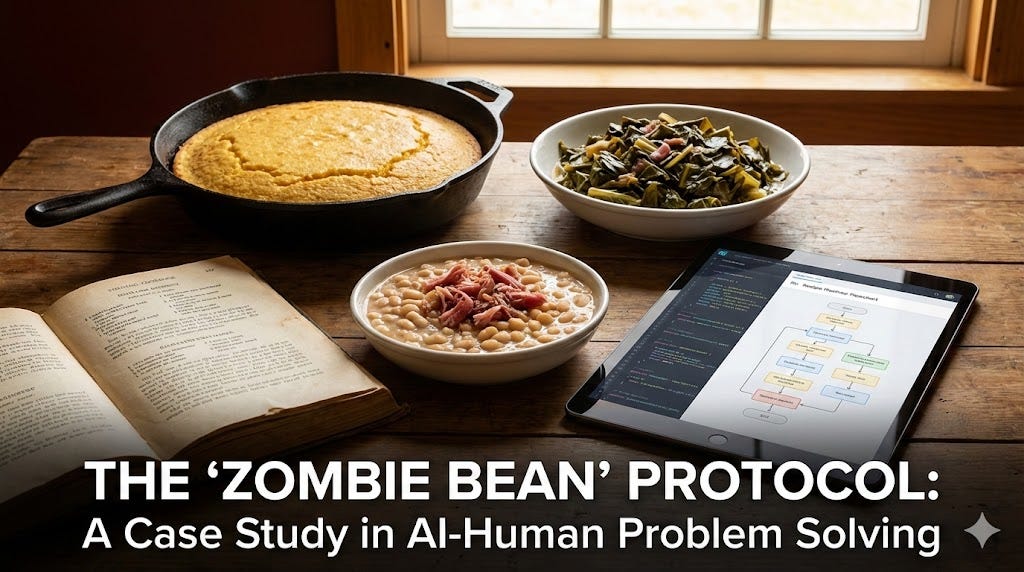
I started 2026 with a simple goal: revive a family tradition. I wanted to recreate the New Year’s Day meal I remember my great-grandmother, Polly Bell, making black-eyed peas, collard greens, and cast-iron cornbread.
To bring this to life, I turned to my AI partner. We didn’t just look for a recipe; we collaborated on the entire experience. We explored the cultural history of the “humble cowpea,” sourced the techniques for a smoky pot liquor, and even mapped out a grocery list. It was a perfect example of AI as a cognitive partner: handling the food history, the chemistry of “low and slow” cooking, and the logistics of a multi-dish meal.
First I’ll share a little history of the tradition...
The Tradition: Why Black-Eyed Peas?
The tradition of eating black-eyed peas on New Year’s Day is primarily a Southern U.S. custom, but its roots are a blend of Sephardic Jewish history and West African culture. Great Grandam was born and raised in Mississippi, although she was neither Jewish nor Black.
Luck and Prosperity: The peas represent “coins,” and they are traditionally served with greens (representing paper money) and cornbread (representing gold).
The “Humble” History: During the Civil War, black-eyed peas were often the only food left behind by Union soldiers because they were considered “cowpeas” or animal fodder. For those who survived on them, the peas became a symbol of survival and resourcefulness.
”Eat Poor on New Year’s, Eat Rich the Rest of the Year”: This phrase captures the humility of the dish. By starting the year with a simple, honest meal, you invite abundance for the months to follow.
So after a short history lesson, I set out to revive the tradition and invite some luck into the new year... Ingredients secured and prepped, crock pot set up and peas soaking all before the clock struck midnight. I was feeling confident and excited about this pursuit. Woke up New Years Day, set the pot of peas in motion and waited all day...
Then, reality hit.
Despite an overnight soak and 10 hours in the slow cooker, the dried peas, a thoughtful gift from a relative, remained like pebbles. This is where the human/machine interaction moved from “recipe sourcing” to “real-time troubleshooting.” We worked through the chemistry: we discussed the baking soda trick to raise the pH and the move from slow-cooker to a rolling stovetop boil. But when the science met the stubborn reality of those beans, we had to pivot. The conclusion is that they were “Zombie Beans,” likely so old that their cell walls had become chemically waterproof and beyond resuscitation. (Some luck for me LOL)
To the credit of my Great Grandam’s resisilience and resourcefulness, I made the executive call to salvage the ham hocks and the flavor profile I’d built, by marrying them with a few cans of navy beans I had in the pantry and viola, I’ve salvaged the mishap. It wasn’t the “traditional” bowl of BE peas, but it was a successful recovery of the intent behind reviving the tradition.
Looking back on the experience, the AI provided the framework, the history, and the troubleshooting, but the outcome required human intervention and a healthy dose of pragmatism. It was a reminder that while technology can optimize the process and illuminate the “why,” the final execution and the ultimate meaning stays with us, the human in the loop.
As I sat down to a bowl of navy beans that tasted exactly like childhood, I realized I’d stumbled onto a much better mantra for attracting “luck.” in 2026.
“Use every tool at your disposal, but never leave your luck in the hands of others.”
Happy New Years Everyone! May your 2026 be filled with the best of luck and prosperity!
KK
This true story was written and developed with the assistance of Generative AI tools. All content has been reviewed, edited, and finalized through a Human-in-the-Loop process to ensure accuracy, integrity, and alignment with the values of responsible AI use.